


Sew Without Thinking About Your Thumb, From The First Week, With Single Point Thumb Support.
What it does, and what it does not
Less goes into the joint on every pinch, for the whole time you are working. That is why the ache is less and why it comes on later than it used to.
It is on your hand the whole time you are sewing. Nothing to unfasten when you pick the needle up, and nothing to take off before you start.
It is not a painkiller. Nothing in it is medicated. What it does is take load off the joint while you are using the hand.
It does not change the joint. Whatever is going on in there carries on. This works while it is on your hand, and that is the honest limit of it.
It does not hold as firmly as a rigid splint. A splint holds harder because it stops the thumb moving, and that is why you take it off to sew. This one holds less and stays on.
That is the size of it. Not a treatment, and not nothing. More time in the chair before the thumb decides.
You will notice it in the work before you notice it in the hand.
One pad, and where it sits is the whole of it.
A knitted sleeve that covers the palm and the wrist. The fingers come out of it. The thumb comes out of it and moves. Sewn inside, low down where the thumb meets the hand, is a shaped pad that sits against the joint. No metal, no straps, nothing running down the forearm.

Where the pressure lands
When you pinch the needle and pull it through, the base of your thumb is pushed sideways across its seat. The pad sits against that joint, on the side the push comes from. So the push meets the pad, and less of it reaches the joint. That happens on every stitch, all the way through the work.
The thumb keeps working
Nothing crosses the thumb and nothing holds it in a position. It bends, it reaches across to your fingers, it pinches and it lets go, exactly as it does with nothing on. The support sits at the joint while the joint goes on working, so you are not trading movement for it.
It stays on while you sew
Nothing running up your forearm. Nothing across your fingers. Nothing to unfasten when you pick the needle up. The knit is what holds the pad in place, so the pressure comes from the fit rather than from anything you set, and it is the same every time it goes on.
All three have to be true at the same time.
Each one is something that failed further up. The pressure has to land on the joint and not on the hand. The thumb has to keep moving. And you have to be able to wear it while you work. Take any one of them away and you are back to something you take off before you start.
What that buys you is time. The joint takes less of that push on every stitch, so the ache turns up later than it used to and you are still working when you would normally have put it down.
Which one of these is your thumb?
People arrive at this from different places. Most of them are on this list.

It hurts at the base of the thumb when you use it. Not the same every day, and worst doing the work you actually wanted to do.
The hand work has been going to the machine, one job at a time. The binding, or the hand quilting, or both. Not because you wanted it that way.
Stiffness and swelling are the bigger part of it. Worst first thing, and the hand takes a while to come back to itself.
The strength has gone out of the pinch. Jars, scissors, a needle through three layers, all of it takes more than it used to.
Surgery has come up. Somebody has mentioned it or offered it, and you are not ready to say yes.
You have cut back without deciding to. Shorter spells, smaller jobs, and you put it down earlier than you meant to.
Those are six different hands. Underneath all of them is the same joint, taking the same push every time you pinch, with nothing on that side of it.
Whichever line was yours, that is the part this is for.
Quilters who had started putting the work down

"I had nearly given up on English paper piecing because every brace I tried made my thumb completely rigid and I couldn't keep a leather thimble on to save my life. This knit sleeve doesn't bulk up around the knuckle. It doesn't make everything brand new, but I can pick up fine needles and baste small hexies without dropping pins every two minutes."

"My therapist told me years ago not to leave a hard splint on all day because the muscles around the thumb base just get weak and stiff from sitting frozen. I keep these by my sewing chair and only slip one on when I sit down for hand applique or hand quilting. The thumb still moves and does the gripping work, but the sewn-in pad takes the push when I press into the fabric. I take it off as soon as I stand up from the table. Fits how I actually work."

"Spreading my palm to feed heavy cotton and batting under the sewing machine walking foot used to leave the base of my thumb throbbing by the second seam. Regular braces have plastic stays that bang right against the machine bed, but this one has no hardware at all. It took a few sewing sessions to get used to the compression, but now I can guide large yardage through without fighting the sleeve."
Swipe for more
Side by side
Next to the two you already own
| Single Point Thumb Support | Compression glove | Immobilising thumb splint | |
|---|---|---|---|
| Sewing in it | Stays on through the work | Stays on | Comes off before you start |
| Where the support lands | On the joint at the base of the thumb | Shared over the whole hand | Over the thumb and up the wrist |
| The push when you pinch | Met by the pad, on the side it comes | Not met | Prevented, and the pinch with it |
| How long you get | Still going when you would have stopped | The same session as before | Whatever you manage without it |
Sewing in it
Where the support lands
The push when you pinch
How long you get

"Holding a quilting hoop with my left hand while stitching with my right used to cramp my thumb joint after twenty minutes. The sleeve gives just enough firm contact at the base so my left thumb doesn't have to clamp down so hard to anchor the frame. Kept me stitching through the afternoon."

"Trimming through multiple layers of cotton and batting with heavy shears always jammed plastic splint edges right into the base of my thumb. I tried this sleeve because there are no metal stays or stiff plastic ribs digging into the palm. It doesn't magically make my hands twenty years younger, but the pad cushions the handle pressure so I can trim blocks without having to stop after every two cuts."

"Both of my thumbs have given me trouble for years, but pulling thread through tight piecing is where the pinch really acts up. I've had these sleeves for about a month now and only wear them when I sit down with my sewing basket. They don't lock your hand like the bulky contraptions from the pharmacy, and that is precisely why they work for needlework. The knit hasn't stretched out and the inner pad stays seated against the joint while I work. It's a sensible tool for anyone who refuses to put their hand projects away."
Swipe for more
Before you decide
Will wearing it make my thumb weaker?
No. It does not hold the joint still.
Your thumb bends, pinches and moves in it just as it does without it. The pad sits over the joint while the joint goes on working, so nothing is being held out of use.
How long should I wear it?
Wear it whenever you are using your hands. Most people put it on when they sit down to sew, but there is no reason to take it off for the jar, the scissors or the washing up. Those cost the joint too.
Take it off at night. It works while you are pinching, so there is nothing to gain from sleeping in it.
Do I get one for each hand?
Yes. It comes as a pair, so both hands are covered. We do not split pairs or sell them singly.
Will it help with arthritis at the base of the thumb, De Quervain's, or trigger thumb?
It sits over the base of the thumb and the thumb side of the wrist, which is the area involved in all three. What it does there is support that area while you use your hand, so the joint takes less of the load every time you pinch.
What it does not do is treat any of them. It is not a medical device and it does not cure anything. It is a support you wear, and what it gives you is time before the hand tells you to stop.
How do I know my size?
It comes in three sizes, measured across the flat width of the wrist. S is up to 7.4 cm (about 2.9 in). L is 7.5 to 8.4 cm (about 3 to 3.3 in). XL is 8.5 to 9.5 cm (about 3.3 to 3.7 in).
To find your size, lay your hand palm up on a flat surface and measure straight across the narrowest part of your wrist with a ruler. Measure across the wrist, not around it. If you are between two sizes, take the larger. If you measure wider than 9.5 cm, even the XL will be too tight, and this is not the one for you.
If the size is wrong, get in touch inside the 60 days and send it back to us, and we will send the right one out. The postage back is yours, the replacement is on us.
Shipping & 60-Day Guarantee
Processed within 24-72 hours, delivered free within 6-10 days with tracking.
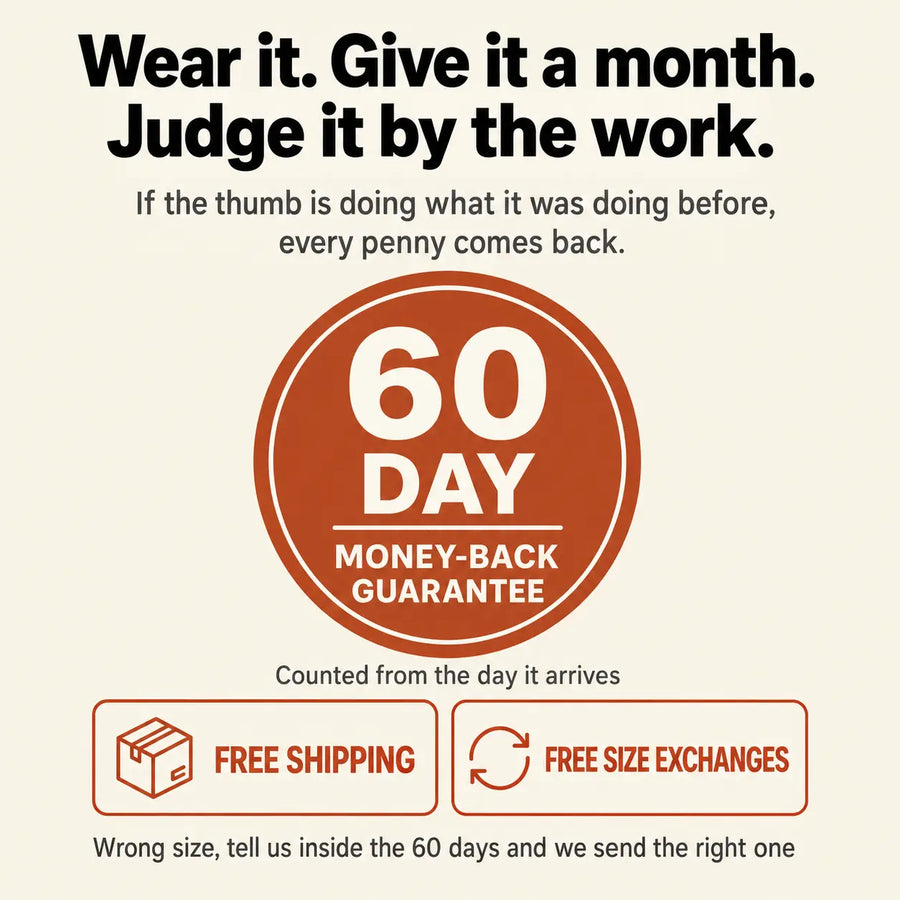
Your sixty days start the day it arrives, not the day you order. Wear it however much or little you like. If the thumb is doing what it was doing before, tell us and every penny comes back.
Judge it by the work
What it does not do, first. It is not a painkiller and nothing in it is medicated. What it does is meet the push at the joint while you work, so less of it lands there, and the ache is less and comes on later than it used to. It does not hold as firmly as a rigid splint either. It holds a pad against the base of the thumb and leaves the thumb free to move, and that is why it is still on your hand when the needle goes through. And if the trouble is in your fingers or your wrist rather than at the base of the thumb, this is not the thing.
You get 60 days, counted from the day it arrives. Give it a month before you decide anything, wear it for the work rather than for the ache, and judge it by what got done rather than by how the hand felt.
Whether the ache turns up later than it used to. Whether you are still going at the point you would normally have stopped. And when a binding comes round, whether it goes on by hand.
If none of that has changed, send it back inside the 60 days and every penny comes back. And if the size is wrong, get in touch inside the 60 days and send it back to us, and we will send the right one out.
Free shipping. 60 day money back guarantee, counted from the day it arrives.